About
For millennia, outsiders have shaped how the Roma are seen — through art, history, music, literature, and science.
Recently, gadje have permitted us a voice — but only to echo what suits dominant narratives, which we boldly challenge. Now we seize this moment to share our own vivid, authentic view of humankind, breaking from centuries of silent observation.
To say it in Gen Z lingo: I'm straight-up vibin', dumpin' all my chaotic feels and mad inspo — totally fueled by my past — into my art. I'm goin' full send on droppin' banger creations that hit different now and keep that glow-up energy poppin' for the future, no cap.

Inside out and about
Dušan Ristić, a Roma man, native Romani speaker, and fifth-generation musician born in the 1970s in Valjevo, former Yugoslavia, passionately pursues art, music, philosophy, and disruptive technologies like blockchain and AI, dedicating his life to creativity and Romani advocacy. Having resided in the San Francisco Bay Area for over 20 years, his work continually explores the dynamic social interactions between clashing or seemingly opposing cultures, fostering understanding and connection.
Education and Achievements
1986–1993 · Early Artistic Foundations (Serbia). Dušan began his artistic journey with private training under master artists Milomir Romanović, Svetlana Knežević, and Gradimir Petrović in Valjevo and Belgrade. Despite the Yugoslav wars beginning in 1993, Dušan gained admission to the highly selective Faculty of Fine Arts at the University of Belgrade (accepting only 26 students annually), where he began studying traditional oil painting, objects, photography, installations, and landscape art.
1993–1997 · Emerging Artist Amid Conflict. Dušan continued to thrive, winning first prize in a 1995 National Student Drawing competition. In 1996, he co-founded Prosopon, an arts magazine and artists' group in Valjevo. In 1997, he co-founded the renowned Romani band Kal as a violinist and singer and exhibited his solo show "Introspection" in Belgrade and Novi Sad. From 1997–2002, he was active in the Rromani Cultural Center in Belgrade and the Vareso Aver Theater in Budapest, both founded by his brother, Dragan Ristić. Dušan collaborated with Dragan to design sets and translate notable works into Romanes, including Federico García Lorca's Blood Wedding, and other plays by Ionesco, Jovan Nikolić and Goran Stefanovski.
1997–2001 · War and Transition to Activism. The intensifying war disrupted his studies in 1997, largely pausing his art for seven years. To avoid being drafted into the Yugoslav war, Dušan was smuggled to Budapest, where he dedicated himself to Romani activism. In 1999, a month at Rajko Đurić's School for Romani Culture in Berlin deepened his activism and inspired him to found the global Romani Crisis Network. In 2000, Dušan created the installation I Simply Cannot Understand for International Rroma Day at the Central European University in Budapest, a powerful artistic response to the racially motivated murder of a Romani woman. He also initiated the International Romani artists' group "G" with participants from eight different countries.
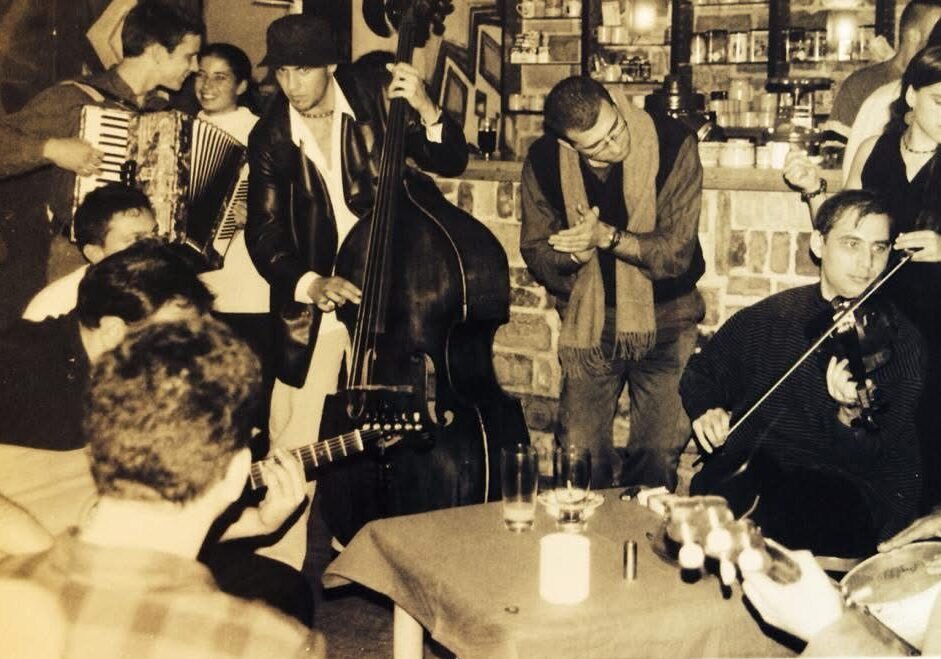
2001–2003 · Building Cultural Spaces. Dušan founded the Amala Summer School for Romani Culture in Valjevo (2001–2017), teaching language, dance, and music. He organized Romani artists' retreats in Hungary (2001) and Serbia (2003) and, in 2002, founded Beograd Šaptač, a Belgrade cultural guide, while working as a translator for the documentary "The Brass Music Oscar" funded by National Geographic and ARTE TV.
2004 · Return to Art and New Beginnings in California. Encouraged by his university professor, Dušan resumed painting, completed his fine arts degree in Belgrade, and moved to California. He held a solo exhibition at San Francisco's Backstage Gallery and launched Amalipen, an online social networking platform (2004–2006), connecting the global Roma community.
2007–2009 · Art Exhibitions and Creation. Dušan exhibited at the Venice Biennale (2007) and HEADHORSE Los Angeles (2009), later creating the Genetic Code oil-on-canvas series inspired by California's landscapes.
2009–Present · Music and Tech in the San Francisco Bay Area. From 2009–2014, Dušan led DUDADA, a social e-commerce platform. He continued running the Amala Summer School for Romani Culture until 2017 and served on the Voice of Roma board from 2004–2014. He founded and performed with two Roma bands — Galbeno band and KALA.
Legacy
Dušan's life seamlessly blends Roma heritage with artistic and technological innovation. Through founding cultural initiatives, creating thought-provoking art, and embracing blockchain and AI to uplift the Roma community, he amplifies Romani voices and fosters connection, leaving a lasting impact with his creativity and activism. For the past nine years, he has prioritized family, cherishing fatherhood as his greatest achievement.